Product Details
About the Designers
Don Chadwick United States (1936 - )
In the last few decades, Don Chadwick has pioneered the use of modern materials, moulding processes and mechanisms leading to cutting-edge products that have raised the standard for their market. A native of Southern California, Don Chadwick received his principal training in design at the University of California, Los Angeles. He then worked for architect Victor Gruen before establishing his own practice in 1964. In 1974, Chadwick designed Chadwick Modular Seating. In collaboration with William Stumpf he designed the Equa 1 flexing-plastic chair (1984). Then in 1994, the landmark Aeron chair catapulted Chadwick to national attention, the Industrial Designers Society of America and Business Week Magazine awarded Design of the Decade to the Aeron chair in 1999. Chadwick has received numerous awards over the past three and a half decades. Chadwick's relationship with Knoll marks a milestone in the career of an inventive designer. "I am gratified to be part of the Knoll legacy, I consider Knoll to be at the highest level of contemporary design, and our collaboration is a notable one for me." with the Chadwick chair, he has proven himself as effective at bringing a product to market as he has been at creating the market itself.
Bill Stumpf The design that fulfilled these criteria met all expectations and shattered some of them. It wasn't upholstered. It wasn't padded. It was dimensioned in three models that looked exactly alike and that had nothing to do with their users' job titles. It didn't look like any other office chair. And its revolutionary concept incorporated more patentable ideas than any previous Herman Miller research program."It was a matter of deliberate design to create a 'new signature shape',"says designer Bill Stumpf. "Competitive ergonomic chairs became look-alikes. Differentiation was a huge part of the Aeron design strategy, and it remains one of, if not the most, critical aspects of Aeron's success."With its highly adjustable features, its breathable and supportive Pellicle fabric suspension technology, and its unique back support options, the Aeron accommodates the sitter like no other office chair on the market.
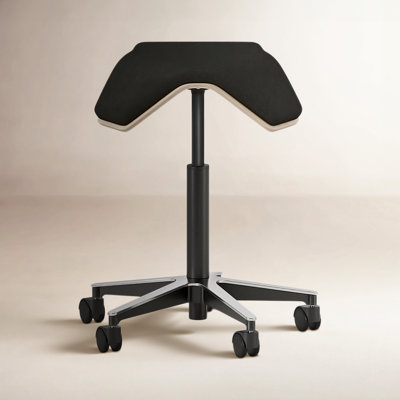
Combining distinctive looks with pioneering ergonomics, Aeron performs like no other chair. It adapts naturally and adjusts precisely to fit people of all sizes and postures doing all kinds of activities, all day long. The imaginative design of this chair gives superior comfort, body support, and style that is widely copied but never matched.
WHY BUY FROM US?
- Wayfair stands behind our on all Herman Miller chairs
- Wayfair backs a 12-year manufacturer – if you have any problem with your
*except in Massachusetts and Utah
FEATURES
- Graphite base and frame finish
- Available in one of 13 lightweight and breathable Pellicle® fabrics, which distribute the user's weight evenly over the chair's seat and back
- Available with optional adjustable lumbar support
- Features pneumatic seat-height adjustment and two height options
- Features ergonomic footring mechanism that allows user to adjust height of the footring from seated position, reducing pressure on underside of user's thighs
- The height-adjustable fine-tune footring moves up and down with the seat pan; once properly adjusted, it is always at the right position
- Fixed arms with black nonupholstered armpads
- Kinemat® tilt lets the body naturally pivot at the ankles, knees and hips
- Tilt tension has 103 revolutions
- 5-star base with your choice of standard carpet casters, hard floor casters or deep carpet casters
Kinemat® System - Tilt geometry based on natural human body linkages
- Accommodates all of the three basic seated postures identified through research at George Washington University by designer Bill Stumpf
- Design corresponds to natural linkages with movements in line with the normal movement (kinematics) of the human body
- Sitter's feet, arms, and back support remain in place whether reclining or leaning forward for effortless transition between postures
Optional Lumbar Support - Added comfort and stability
- Lumbar pad connects to chair back and adjusts vertically through a 4.25 height range
- Lumbar support D can be increased or decreased between 1.25 and 0.75 by simply sliding the pad off and turning it around
- Maintains proper spine alignment and promotes greater overall comfort through hours of seated work
Casters - Three different caster options can accommodate any style of flooring:
- Standard casters – work well on most low pile office carpets (wheels 2 ½” W)
- Deep-carpet casters – loose design and larger size (3” W) help the user avoid snags and move easily across thicker carpets
- Hardwood casters – thin rubber coating prevents damage to flooring and provides greater traction on non-carpeted surfaces
Lumbar Support
- Added comfort and stability
- Maintains proper spine alignment and promotes greater overall comfort through hours of seated work
Casters
- Four different caster options can accommodate any style of flooring
- Hardwood casters – thin rubber coating prevents damage to flooring and provides greater traction on non-carpeted surfaces
Shipping Note: - Chairs that have a High Height, Back Support of Adjustable Lumbar Support, and a Fabric choice of Pellicle Classic - Carbon have the option of same - day shipping
- All other options ship in 6 -8 weeks
DIMENSIONS
Low Stool:
- Seat Height: 24.5" - 29"
- Seat W: 20.25"
- Seat D: 17"
- Overall Height: 52.25" (max)
- Overall W: 27"
- Footring Height: 15" - 17½" (from seat)
High Stool:
- Seat Height: 27.25" - 34"
- Seat W: 20.25"
- Seat D: 17"
- Overall Height: 57¼" (max)
- Overall W: 27"
- Footring Height: 15" - 20.5"
DESIGNERS DON CHADWICK AND BILL STUMPF
Herman Miller turned to designers Don Chadwick and Bill Stumpf to design a totally new kind of work stool. Chadwick's and Stumpf's previous collaboration had produced the groundbreaking Equa chair.
The two designers began this development process with a clean slate, with no assumptions about form or material, but with some strong convictions about what a chair ought to do for a person.
Ergonomically, it ought to do more than just sit there. It should actively intercede for the health of the person who sits in it longer than she should.
Functionally, it ought to move and adjust as simply and naturally as possible. It should support a person in any position he cares to assume, at any task his office job serves up. Anthropometrically, it ought to be more inclusive than its predecessors. It should do more than accommodate small or large people; it should really fit them.
Environmentally, it ought to be benign. It should be sparing of natural resources, durable and repairable, designed for disassembly and recycling; made largely of recycled materials, the Aeron Work Stool is designed to last a long time, with parts that get the most wear easily replaced and recycled. It's just what you would expect in a well thought-out design.
The design that fulfilled these criteria met all expectations and shattered some of them. It wasn't upholstered. It wasn't padded. It was dimensioned in three models that looked exactly alike and that had nothing to do with their users' job titles. It didn't look like any other office chair. And its revolutionary concept incorporated more patentable ideas than any previous Herman Miller research program.
See something odd? Report it here.
Thanks for helping us be 100% accurate.